
Engineered for Speed, Control & Grounding
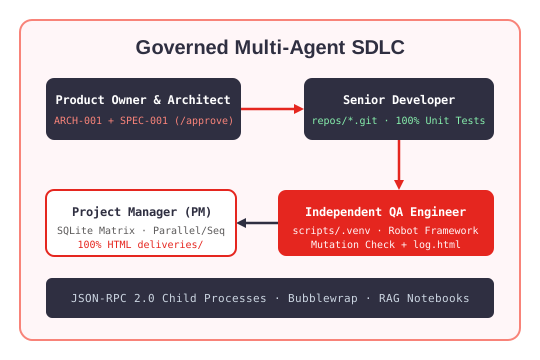
POCLI rejects monolithic prompt bloat. Every specialist runs in an isolated Linux process with role-bounded tools, deterministic SDLC governance, and sub-second Time-To-First-Token.
Minimal Harness & Token Efficiency
Inspired by Pi (pi-mono) and empirical findings from Harness Engineering (arXiv:2609.00006), POCLI replaces monolithic 15,000+ ...
3-Tier Context & SQLite DAG
Built on Node.js Native SQLite (node:sqlite) in WAL + FTS5 mode, POCLI stores the entire engineering history in $HOME/.pocli/po...
Autonomous QA & Robot Framework
Following the strict “No Self-Review” engineering principle, the Senior Developer never validates their own code. Once unit tes...
PM Agent & 100% HTML Reports
The Project Manager (PM) provides unified visibility across all virtual engineering specialists without ever interfering with t...
Knowledge Notebooks & Hybrid RAG
POCLI adapts grounded citation research (arXiv:2311.09533) and the NotebookLM / Open Notebook paradigm directly onto your local...
Linux Sandboxing & Multi-Model Router
Every virtual specialist executes in an independent Linux child process communicating via newline-delimited JSON-RPC 2.0 over s...
AI Agent Harness Reference Matrix & POCLI Coverage
Consolidated architectural taxonomy of the 9 essential capabilities of an AI Agent Harness, why raw LLM API calls fall short, and the exact implementation status in POCLI.
| Pillar / Core Capability | What It Is (Definition) | Problem Solved | Key Components / Concepts | Priority Level | POCLI Status & Technical Implementation |
|---|---|---|---|---|---|
|
01
Operational Loop & Execution Control
|
Orchestrates the master cycle (prompt -> inference -> tool dispatch -> observation), streaming progress to the UI and enforcing strict iteration bounds and timeouts. |
Raw API calls cannot self-correct when code or tests fail, risk infinite retry loops, block user interfaces, or hang indefinitely on stalled requests. |
Core (MVP) |
Implemented
How it works in POCLI:
PoCliOrchestrator drives agent turns over JSON-RPC 2.0 stdio workers (PersistentAgentRuntime), streams incremental updates via agent.streamChunk to CommandCenterApp, bounds autonomous DEV<->QA rework with MAX_QA_CORRECTION_CYCLES = 3, and enforces 120s per-turn worker timeouts.
Pending:
Semantic stuck-loop detector (aborting repeated identical failures) and native HTTP SSE token-by-token streaming across every provider adapter.
|
|
|
02
Model Gateway & Smart Routing
|
Unified multi-provider LLM abstraction that normalizes payloads, tracks sliding-window rate limits, scores candidates, and executes automatic failover. |
Hardcoding a single LLM vendor exposes workflows to HTTP 429/503 outages, latency spikes, provider lock-in, and fragile credential handling. |
Core (MVP) |
Implemented
How it works in POCLI:
LLMGateway and LLMRouter (llm-router.ts) unify OpenRouter, Groq, Cerebras, Gemini, Pollinations, Ollama, Anthropic, and OpenAI with routing presets, sliding-window quota tracking, cooldown timers, automatic HTTP 429/503/timeout cascade failover, and cleanModelOutput() sanitization.
Pending:
Per-error exponential backoff with jitter prior to failover and automated shadow/canary routing evaluations.
|
|
|
03
Typed Tooling & Schema Dispatch
|
Deterministic registry and execution layer exposing workspace, test, and artifact actions per agent role with structured contracts and controlled loading. |
Unconstrained free-text parsing breaks automation, exposes host paths outside the project, and wastes prompt tokens by injecting unused tools upfront. |
Core (MVP) |
Implemented
How it works in POCLI:
harnesses.ts enforces strict per-role allowedTools (architect, developer, qa, pm), while PoCliOrchestrator.executeAgentToolCalls() dispatches typed artifact, source, test (run_unit_tests), QA provisioning (install_qa_tool, run_qa_suite), and handoff calls. LLMGateway merges native choiceMsg.tool_calls with extractToolCalls() backed by Zod schemas.
Pending:
Passing full JSON Schema tools[] definitions natively in HTTP payloads for all providers and Just-In-Time (JIT) deferred tool loading for large catalogs.
|
|
|
04
Context Engineering & Layered Memory
|
Deterministic context assembler combining cache-friendly normative prefixes, tiered memory, lossless compaction checkpoints, and local hybrid RAG retrieval. |
Unbounded chat histories cause context rot (lost in the middle), forget architectural decisions, and inflate token spend on every turn. |
Core (MVP) |
Implemented
How it works in POCLI:
PoCliDatabase.assembleAgentContextWindow() builds 3-tier prompts: (T1) cacheable normative artifacts prefix, (T2) 4-layer memory + latest context_compactions checkpoint via /compact (marking compacted_into_id without deleting history), and (T3) active uncompacted turns. NotebookRagEngine indexes workspace notebooks via SHA-256 + SQLite FTS5 + vector similarity.
Pending:
Automatic provider-threshold compaction triggered transparently before context saturation without requiring manual /compact.
|
|
|
05
Governance, Authority & Sandboxing
|
Hard policy-as-code rules, single-writer state integrity, Human-in-the-Loop gates, and OS namespace isolation constraining what agents can mutate or execute. |
Without deterministic guardrails, agents can overwrite peer artifacts, skip verification gates, corrupt shared state, or run unsafe commands directly on the host. |
Core (MVP) |
Implemented
How it works in POCLI:
AuthorityGuard (workflow.ts) validates every SDLC phase transition and artifact permission; PoCliCoordinator serializes SQLite writes as Sole Write Owner with idempotency (requestId), optimistic concurrency (expectedVersion), and coordinator_audit_log; LinuxAgentProcessRunner isolates workers via Bubblewrap (/usr/bin/bwrap --unshare-pid) or Podman OCI containers, while /approve and /accept enforce Product Owner gates.
Pending:
Mandatory default seccomp and fine-grained per-tool network-deny policies even when running in lightweight local mode.
|
|
|
06
Persistence, Checkpoints & Durability
|
ACID transactional storage of sessions, artifacts, layered memory, and compaction checkpoints enabling crash recovery, inspection, and reproducible state history. |
In-memory agent state vanishes on process crashes or restarts, breaking multi-session engineering work and making post-mortem audits impossible. |
Core (MVP) |
Implemented
How it works in POCLI:
PoCliDatabase (database.ts) persists projects, messages, versioned artifacts, 4-layer memory entries, compaction checkpoints, and coordinator audit entries inside $HOME/.pocli/pocli.sqlite using Node.js native WAL SQLite. Includes pocli db interactive REPL and JSON/SQL inspection CLI.
Pending:
Deterministic step-by-step session replay (time-travel debugging) and turn branching/rewind from immutable state snapshots.
|
|
|
07
Multi-Agent Orchestration & Handoffs
|
Coordinated execution of isolated specialist agents across separate OS processes using zero-context-bloat assembly and structured inter-agent handoffs. |
A single generalist agent grades its own code, mixes incompatible personas, and pollutes reasoning context with irrelevant cross-role noise. |
Advanced / Production |
Implemented
How it works in POCLI:
PersistentAgentRuntime spawns isolated workers per (projectId, role) across architect, developer, qa, and pm. Each specialist receives only its assembled context window and RAG citations (zero cross-chat bloat). PoCliOrchestrator automates [ARQ->DEV], [DEV->QA], bidirectional DEV<->QA defect loops, and external Robot Framework + TC-MUT-001 validation.
Pending:
Concurrent fan-out / fan-in parallel execution of multiple developer subagents across disjoint modules.
|
|
|
08
Extensibility: MCP, Plugins & Skills
|
Standardized interfaces to attach external tool servers, packaged extensions, custom role behaviors, and reusable skills without modifying the core runtime. |
Hardcoding custom integrations for every database, tracker, or API turns the harness into a brittle monolith that cannot adapt across teams. |
Advanced / Production |
Partial
How it works in POCLI:
McpRegistry (mcp-client.ts) discovers and invokes external Model Context Protocol servers over JSON-RPC 2.0 stdio with strict per-role allowlists (allowedRoles), and harnesses.ts supports user behavior overrides in $HOME/.pocli/behavior/system/
Pending:
Declarative plugin package loader, dynamic skill registry (SKILL.md / lifecycle hooks), and remote HTTP/SSE MCP server transport.
|
|
|
09
Telemetry, Cost & Harness Evals
|
Quantitative observability of latency, token budgets, structured audit logs, executive reporting, and automated end-to-end evaluations verifying harness behavior. |
Without telemetry and reproducible harness evals, regressions from model swaps or prompt edits go undetected and runtime costs spiral unnoticed. |
Advanced / Production |
Partial
How it works in POCLI:
Logger writes ring-buffered rotating logs ($HOME/.pocli/logs/pocli.log); LLMRouter tracks per-provider latencyMs; PoCliDatabase computes active/saved tokens; PmReporter generates 100% HTML reports in deliveries/; and pocli e2e / pocli tui-test plus Vitest + Mutation Testing validate full harness execution.
Pending:
Granular Time-To-First-Token (TTFT) TUI telemetry, per-model USD cost accounting ledger, and OpenTelemetry (OTLP) span export.
|
