AI Agent
What Is an AI Agent?
An AI agent is a computer program powered by artificial intelligence (AI) that can perform tasks autonomously to assist human users, even without definite instructions.
Unlike other AI-powered software, such as chatbots, AI agents can operate outside of a specific prompt-based context. They can go outside of their training data and take a look around at the world, so to speak, to find information. Then they can, on their own, take actions based on that information in pursuit of a larger goal.
AI engineers often encounter tasks that are too complex for a foundational model to perform all at once, so a common tactic is to break the complex task into smaller components that can be accomplished by foundational models. Such small software components that provide capabilities with the help of foundational models are called agents. Agents become increasingly autonomous as they use GenAI models to plan out a sequence of operations, identify the backend tools that they can invoke for each operation, determine how to recover from errors, and/or evaluate whether the task is complete. Applications that are built by orchestrating agents are called agentic.
Key Characteristics
- Autonomy: Can execute tasks with limited or no step-by-step human direction. In other words, it means the ability to operate independently without constant human guidance or being explicitly programmed to do so.
- Goal orientation: Works toward an objective instead of only answering one isolated prompt.
- Environment interaction: Can gather external information before deciding what to do next.
- Action capability: Can take actions (for example, calling tools or services) based on observed context. Agents can gather the data they need (“perceive”) and act on their environment. You can usually give them this ability by enabling them to call external functions (such as searching the web, invoking calculators, and writing to databases) through Tool Calling.
AI Agent Types (IBM Classification)
Based on IBM’s classification, there are five core AI agent types: simple reflex, model-based reflex, goal-based, utility-based, and learning agents.
| Agent Type | Decision Style | Best Fit | Typical Limitation |
|---|---|---|---|
| Simple reflex agent | Condition-action rules from current input only | Stable, repetitive environments | No memory of past state |
| Model-based reflex agent | Rules + internal state model | Partially observable environments | Model quality affects decisions |
| Goal-based agent | Plans actions to reach a target objective | Navigation, task planning, routing | Planning cost can increase latency |
| Utility-based agent | Chooses action with highest utility score | Trade-offs across multiple objectives | Utility design can be complex |
| Learning agent | Improves policy from feedback and experience | Dynamic or uncertain environments | Needs data, feedback loops, and tuning |
Simple Reflex Agents
Simple reflex agents are the most basic type. They map a current observation directly to an action using predefined condition-action rules.
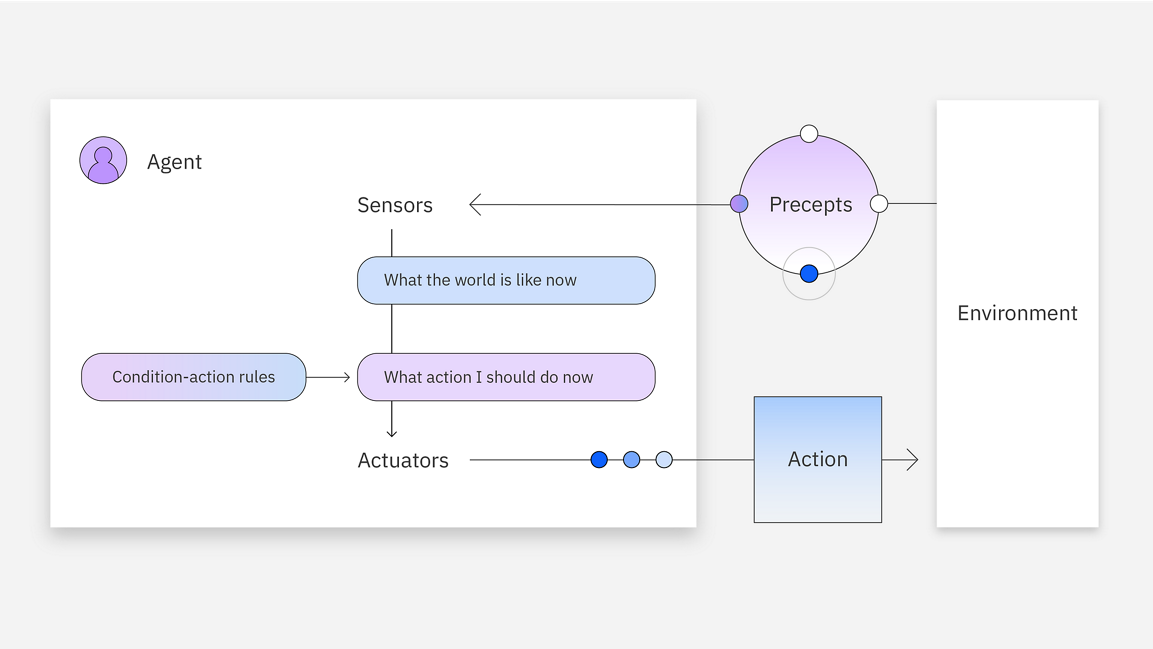
- They do not reason about history or future consequences.
- They work well when the environment is predictable and rules are clear.
- Typical examples include thermostats and basic traffic-signal control.
Model-Based Reflex Agents
Model-based reflex agents extend reflex behavior with an internal model of the world.
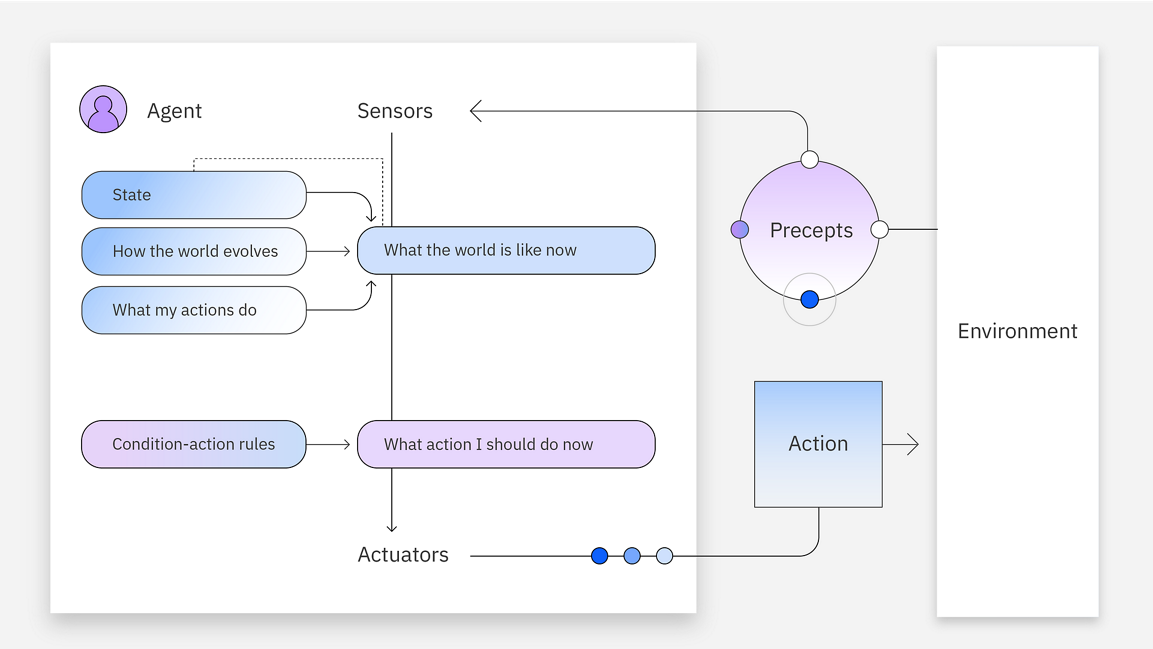
- They still use rules, but also keep track of state from prior observations.
- They perform better than simple reflex agents when not all information is visible at once.
- A common example is a robot that combines current sensor input with remembered obstacle positions.
Goal-Based Agents
Goal-based agents choose actions by evaluating which steps move them closer to a defined objective.
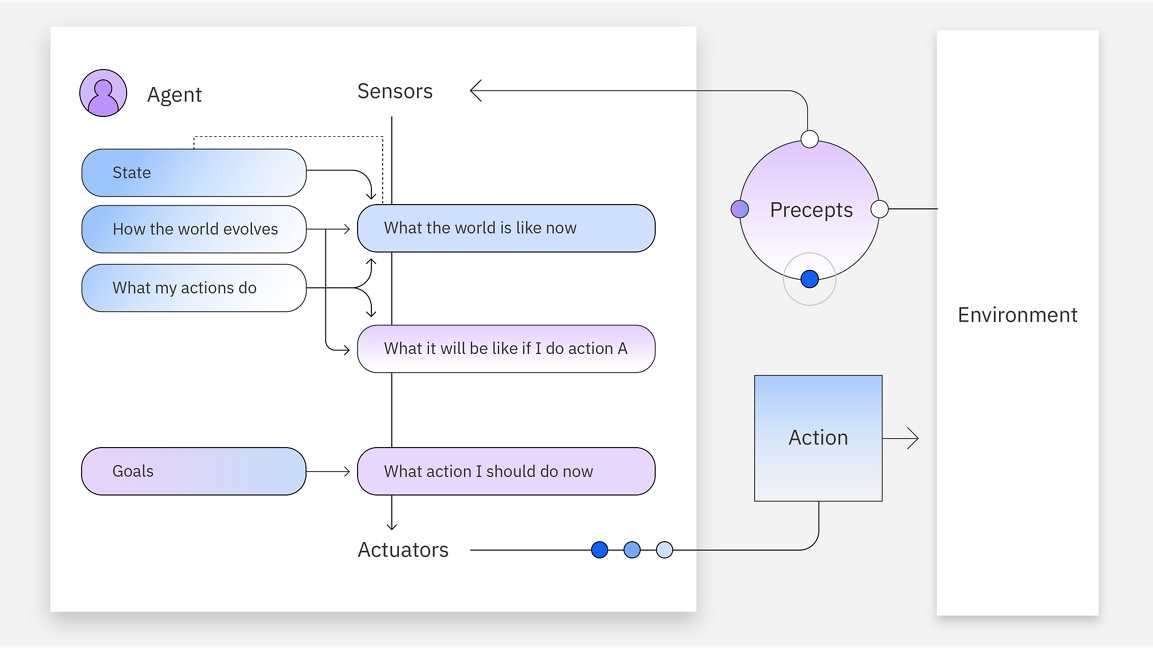
- They are proactive: not only reacting, but planning toward a goal.
- They compare possible actions before acting.
- A navigation robot reaching a specific destination is a standard example.
Utility-Based Agents
Utility-based agents optimize decisions with a utility function, not only binary goal completion.
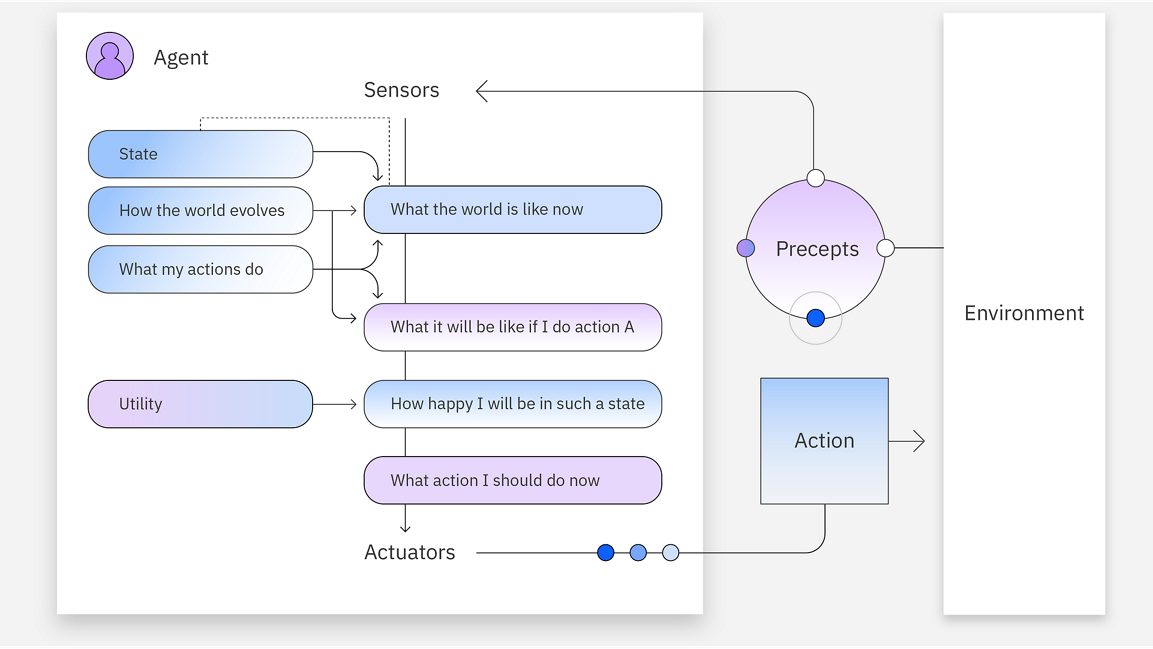
- They score alternatives and pick the option with the highest expected value.
- They are useful when there are multiple objectives and trade-offs (for example speed vs. safety).
- Autonomous driving decisions are a common example of utility-based reasoning.
Learning Agents
Learning agents improve over time by updating behavior from feedback and new data.
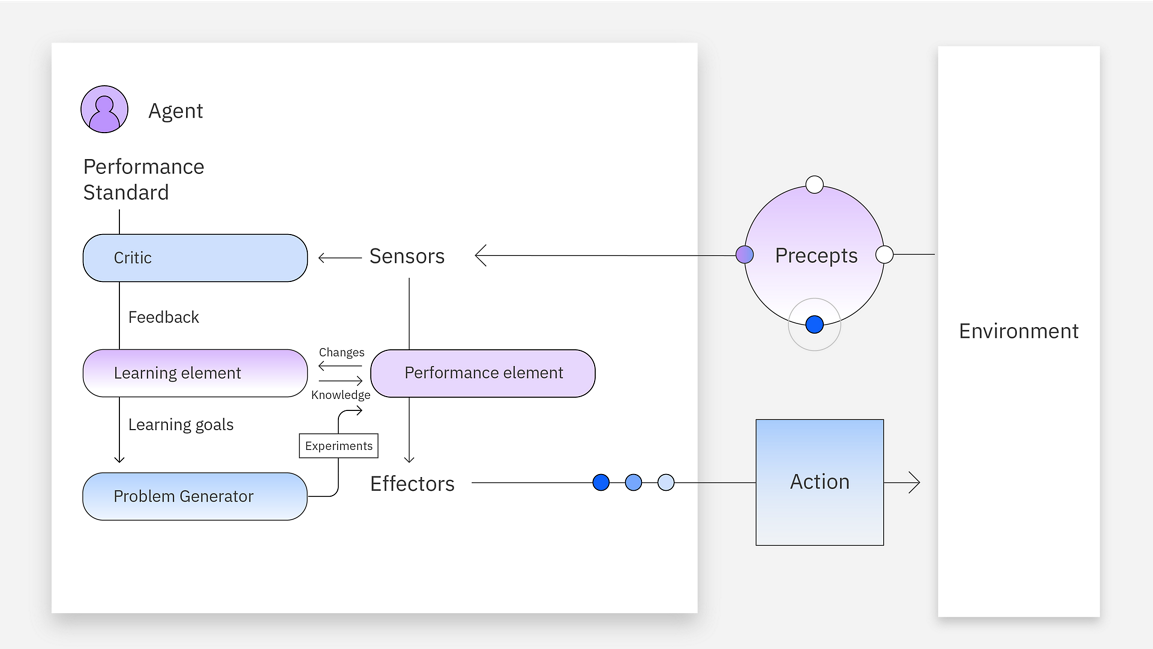
- They adapt to changing environments and uncertainty.
- A common structure includes a performance element, learning element, critic, and problem generator.
- They are strongest when rules cannot be fully predefined in advance.
Classification Notes
- These five types are often combined in practical systems.
- Modern multi-agent systems can assign different agent types to different subtasks.
- Source classification: Types of AI agents - IBM
AI Agents Development
The AI agents ecosystem includes SDKs, frameworks, and managed services. The following table summarizes well-known options for building and operating AI agents in production.
| Tool | Type | Who builds | Ecosystem lock-in | Time to production | Enterprise governance |
|---|---|---|---|---|---|
| Nexus | Platform + service | Business teams | None (4,000+ integrations) | Days to weeks | SOC 2 II, ISO 27001, ISO 42001, GDPR |
| Microsoft Agent Framework | Open-source SDK | Engineers (Python/C#) | Azure/Microsoft | Weeks to months | Azure baseline, custom build required |
| LangChain / LangGraph | Open-source framework | Engineers (Python/JS) | None | Weeks to months | Custom build required |
| CrewAI | Open-source framework | Engineers (Python) | None | Weeks to months | Enterprise tier available |
| Google Vertex AI Agents | Managed cloud service | Engineers + low-code | Google Cloud | Weeks to months | Google Cloud baseline |
| AWS Bedrock Agents | Managed cloud service | Engineers | AWS | Weeks to months | AWS baseline |
| Anthropic Claude Agent SDK | SDK | Engineers (Python) | Anthropic models | Weeks to months | Custom build required |
| OpenAI Agents SDK | SDK | Engineers (Python) | OpenAI models | Weeks to months | Custom build required |
| Copilot Studio | Low-code builder | Business teams + IT | Microsoft | Weeks | Microsoft compliance layer |
| Dify | Open-source platform | Technical users | None (self-hosted) | Weeks | Custom build required |
AI Agent Development Paradigm: Agent Loop
A language model can answer questions. An agent can do things. The agent loop is what makes that difference possible.
When a model receives a request it cannot fully address with its training alone, it needs to reach out into the world: read files, query databases, call APIs, execute code. The agent loop is the orchestration layer that enables this. It manages the cycle of reasoning and action that allows a model to tackle problems requiring multiple steps, external information, or real-world side effects.
This is the foundational concept in Strands. Everything else builds on top of it.
How the Loop Works
The agent loop operates on a simple principle: invoke the model, check if it wants to use a tool, execute the tool if so, then invoke the model again with the result. Repeat until the model produces a final response.
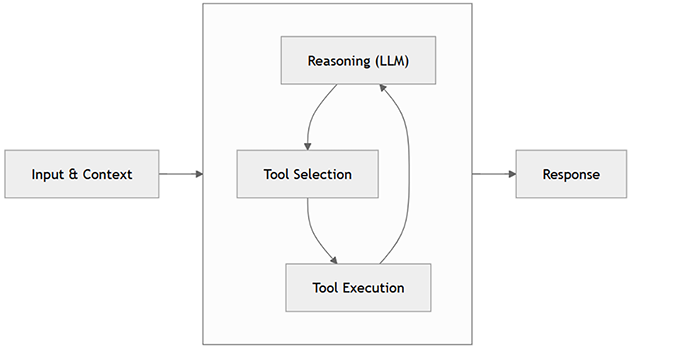
The diagram shows the recursive structure at the heart of the loop. The model reasons, selects a tool, the tool executes, and the result feeds back into the model for another round of reasoning. This cycle continues until the model decides it has enough information to respond.
What makes this powerful is the accumulation of context. Each iteration through the loop adds to the conversation history. The model sees not just the original request, but every tool it has called and every result it has received. This accumulated context enables sophisticated multi-step reasoning.
ReAct (Reasoning and Acting) Framework
The ReAct (Reasoning and Acting) technique is an AI framework that allows models to interleave verbal reasoning traces with dynamic tool execution. Instead of guessing blindly, the AI thinks out loud, uses external tools (like search engines or calculators) to verify facts, and refines its next steps based on real-world results
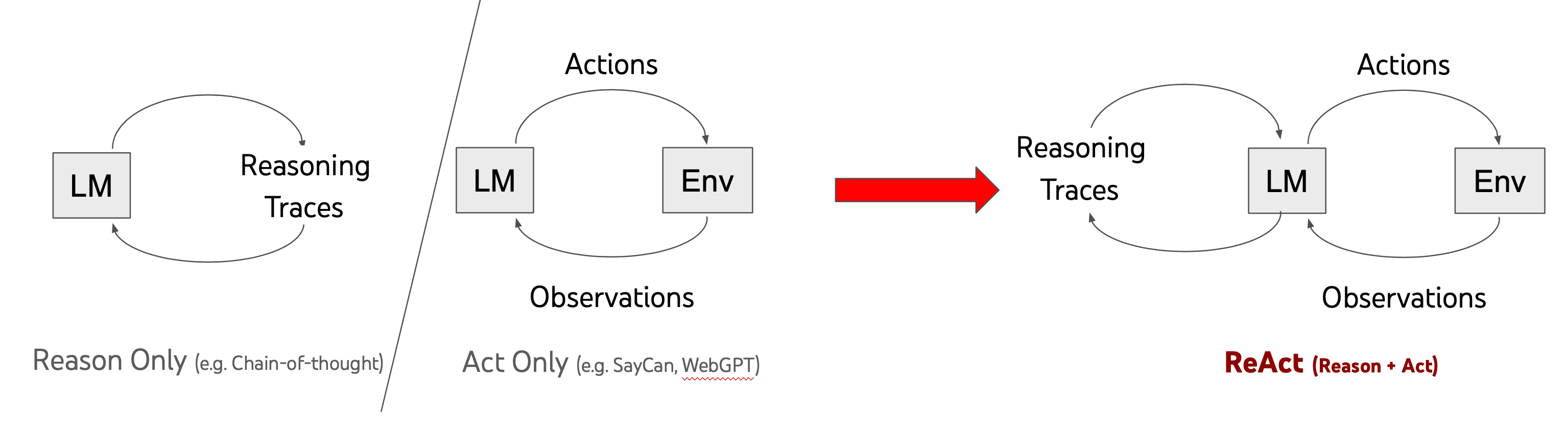
ReAct combines two capabilities that were often treated separately in LLM systems: reasoning (for example, chain-of-thought style planning) and acting (calling tools or interacting with environments). In ReAct trajectories, the model alternates between thoughts, actions, and observations, so each new step is grounded in feedback from the outside world.
According to the project page and paper results, this pattern improves factuality and interpretability in knowledge-intensive tasks such as HotpotQA and FEVER, where external lookup helps reduce hallucination and error propagation. It also shows strong few-shot performance in interactive decision-making benchmarks like ALFWorld and WebShop, where interleaving reasoning with actions helps the model adapt while solving multi-step tasks.
The same framework is flexible across prompting and finetuning settings: prompts can be designed as few-shot reasoning-action trajectories, and early finetuning experiments reported that ReAct-format training can outperform larger prompted models in some scenarios.
Reference:
Open Source Autonomous Agents
This section lists notable open-source AI agents. OpenClaw stands out as a premier autonomous agent, and while there are several similar projects, many of them provide both a fully-featured autonomous agent and an SDK for building custom agents.
| Agent | Language | Focus | Repository | Key Features |
|---|---|---|---|---|
| AutoGPT | Python | Task automation & reasoning | Significant-Gravitas/AutoGPT | Multi-tool orchestration, long-term memory, goal decomposition |
| OpenClaw | Multi | Autonomous reasoning | openclaw/openclaw | Advanced reasoning, tool-use, self-correction loops |
| Hermes Agent | Python | Research & information gathering | NousResearch/hermes-agent | Reasoning backbone, multi-step planning, document retrieval |
| OpenHands | Python | Software engineering agent | OpenHands/OpenHands | Code generation, debugging, IDE integration, environment interaction |
| CrewAI | Python | Role-based multi-agent system | crewaiinc/crewai | Agent orchestration, role definition, task sequencing, SDK for custom agents |
| MetaGPT | Python | Software project planning | FoundationAgents/MetaGPT | Multi-role workflows, document generation, SOPs (standard operating procedures) |
| AutoGen | Python | Multi-agent conversation | microsoft/autogen | Conversational AI agents, code execution, agent composition framework |
| Claude Code | Python | Code-centric development | anthropics/claude-code | Code generation, file I/O, terminal execution, Anthropic integration |
| Devin | Multi | AI software engineer | Cognition-AI/Devin | Full development workflow, debugging, deployment, terminal access |
| BabyAGI | Python | Simple task automation | yoheinakajima/babyagi | Task decomposition, execution loops, minimalist design |