LLM Distillation
What is LLM Distillation?
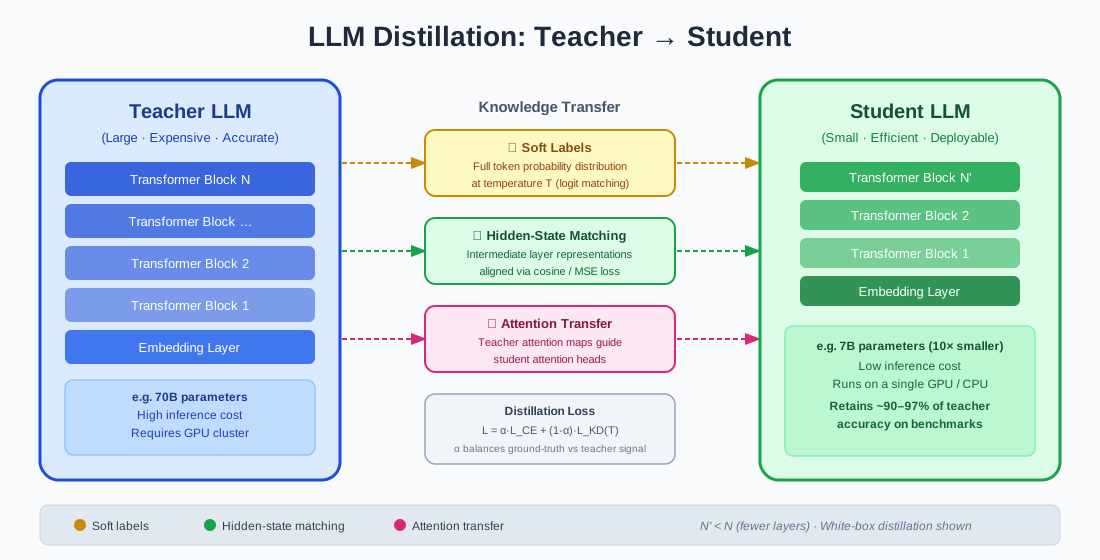
LLM Distillation is a specialized form of Knowledge Distillation (KD) applied to large language models.The goal is to transfer the knowledge encoded in a large, expensive model (the teacher) into a smaller, faster model (the student) while preserving as much of its performance as possible.
The technique makes it feasible to deploy powerful language capabilities in resource-constrained environments — edge devices, latency-sensitive APIs, or cost-sensitive production systems — without retraining from scratch on raw data.
Why Distillation Matters
Training frontier LLMs requires enormous compute budgets and specialized infrastructure. Deploying them at scale can be even more expensive. Distillation addresses this with a favorable trade-off:
| Concern | Large Teacher | Distilled Student |
|---|---|---|
| Inference cost | High | Low |
| Latency | High | Low |
| Accuracy | Baseline | Near-baseline |
| Deployment flexibility | Limited | Broad |
Core Concepts
Teacher and Student Models
- Teacher: the large, pretrained model whose knowledge is being transferred. Examples: GPT-4, LLaMA 3 70B, Mistral Large.
- Student: the smaller model being trained to mimic the teacher. Examples: DistilBERT, TinyLLaMA, Phi-3 Mini.
The student is typically 2–10× smaller than the teacher, with proportional gains in inference speed.
Knowledge Transfer Signals
The teacher provides richer training signals than plain ground-truth labels:
- Soft labels (logit matching): instead of one-hot labels, the student learns from the teacher’s full probability distribution over the vocabulary, capturing the relative confidence the teacher assigns to each token.
- Hidden-state matching: intermediate layer representations of the teacher are used to guide the student’s internal representations.
- Attention transfer: the student is trained to replicate the teacher’s attention patterns layer by layer.
Distillation Loss
The distillation objective combines two terms:
L_total = α · L_CE(student, ground_truth) + (1 - α) · L_KD(student_logits, teacher_logits, T)
L_CE— standard cross-entropy loss against ground-truth labels.L_KD— KL-divergence between student and teacher soft distributions, computed at temperatureT.T(temperature) — scales logits before softmax; higher values produce softer distributions and reveal more inter-class structure.α— weighting coefficient balancing both objectives.
Distillation Strategies
Black-Box Distillation
The student only has access to the teacher’s output text (no logits, no internal states). This is the only option when the teacher is accessed via an API (e.g., GPT-4 via OpenAI).
- The student is fine-tuned on teacher-generated completions.
- Also called data augmentation distillation or imitation learning.
- Lower fidelity than white-box methods, but widely applicable.
White-Box Distillation
Full access to the teacher’s weights, logits, and activations is available. Enables richer transfer signals:
- Logit-level distillation (soft targets).
- Feature-level distillation (intermediate layer matching).
- Relation-based distillation (mutual relationships among samples).
Task-Specific vs. General Distillation
| Type | Description | Example |
|---|---|---|
| Task-specific | Distill on a labeled dataset for a downstream task | Fine-tuned BERT → DistilBERT for NLI |
| General | Distill on large unlabeled corpora to preserve general capabilities | LLaMA 70B → TinyLLaMA on raw text |
Notable Examples
DistilBERT
Introduced by Hugging Face in 2019, DistilBERT is 40% smaller and 60% faster than BERT while retaining 97% of its performance on GLUE benchmarks. It uses:
- Soft-label distillation during pretraining.
- Cosine embedding loss on hidden states.
- MLM (masked language modeling) objective.
TinyLLaMA
A 1.1B parameter model pretrained on 3 trillion tokens using LLaMA 2 as a reference architecture. Demonstrates that small students trained on large token counts can match larger models at a fraction of the inference cost.
Phi Series (Microsoft)
The Phi-1, Phi-2, and Phi-3 models demonstrate that data quality (teacher-generated “textbook-quality” synthetic data) can substitute for scale, producing surprisingly capable small models.
DeepSeek-R1 Distillation
DeepSeek released distilled versions of their R1 reasoning model (ranging from 1.5B to 70B parameters) by fine-tuning open-weight base models (Qwen, LLaMA) on reasoning traces generated by the full R1 model — a prominent recent example of black-box distillation at scale.
Distillation vs. Other Compression Techniques
Distillation is one of several model compression strategies. They are often combined:
| Technique | Description |
|---|---|
| Distillation | Transfer soft knowledge from teacher to student |
| Pruning | Remove redundant weights or attention heads |
| Quantization | Reduce numerical precision (e.g., FP16 → INT4) |
| Low-rank factorization | Decompose weight matrices (e.g., LoRA) |
Distillation differs in that it requires a training phase, while pruning and quantization can sometimes be applied post-hoc.
Limitations and Challenges
- Capacity gap: if the student is too small, it cannot faithfully represent the teacher’s knowledge, leading to degraded performance.
- Distribution mismatch: distillation data must cover the target deployment distribution; gaps cause silent failures.
- Proprietary teachers: black-box distillation may violate the terms of service of closed API providers.
- Compound errors: reasoning chains distilled from teachers may carry reasoning errors that the student amplifies.
- Evaluation difficulty: a distilled model may score well on benchmarks while failing on out-of-distribution inputs.
Key Papers and Resources
- Distilling the Knowledge in a Neural Network – Hinton et al. (2015)
- DistilBERT, a distilled version of BERT – Sanh et al. (2019)
- Knowledge Distillation of Large Language Models – Gu et al. (2023)
- TinyLLaMA: An Open-Source Small Language Model
- DeepSeek-R1: Incentivizing Reasoning Capability in LLMs via RL (2025)
- Hugging Face – DistilBERT model card